Stephanie Hanes
INTERVIEW
ISSUE I
2025Stephanie Hanes
Artists
Issue I, 2025
Burntout (BT): On your website, you describe the importance of the medium of clay. Exhibiting touch gives the viewer the ability to see how things are made, being from the earth. Do you feel an intuitive connection to the medium, as you describe? What does this medium unlock for you when you're using it? What draws you to it?
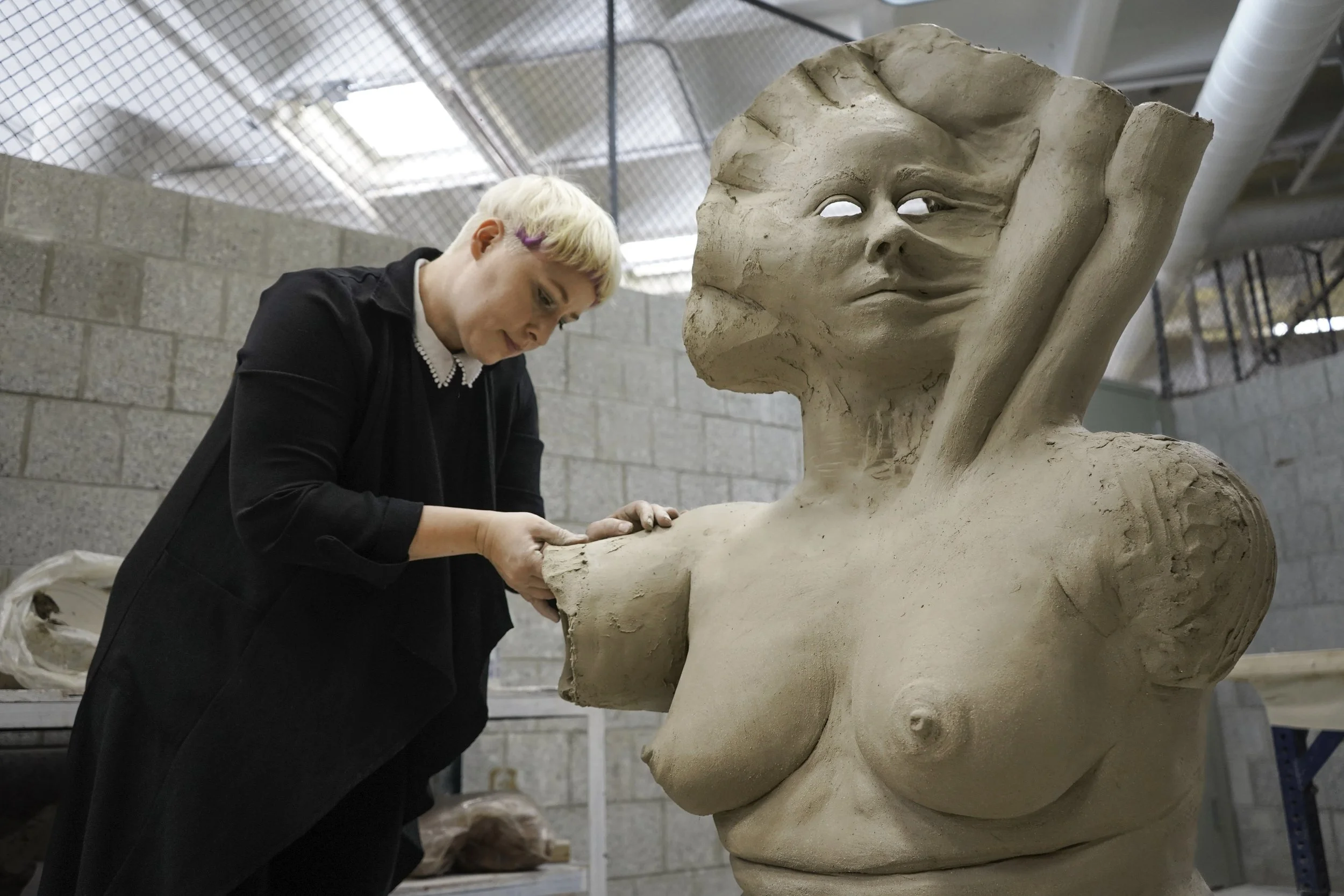
Stephanie Hanes (SH): What is my relationship to clay? Alright. Five questions in one haha. One thing that I like about clay is, as I said, it shows touch. If you look at neolithic vessels that have been around since 10,000 BC you can see that person's fingerprint embedded into the clay. It gives a freshness. It’s not bound by time. And the process of clay going through this metamorphosis is special, it’s a metaphorically poignant material for me with that idea of movement. It's held in a moment of stasis… I'm still contending with this idea of motion and stasis with the medium because my work/ceramics are very still, of course. However, it's in motion simultaneously, with the repetition. The intuitive nature of connection to the medium is that we are made of the earth. So maybe it's a connection to the ineffable because we are building with a material that is what we are. Also, the thing I like about clay is that once it’s fired, it’s forever. It can be broken down, shattered, and pulverized, but it’s never diminished. You can think about it as a soul, almost, or an energy that transcends death in that sense. Something beyond.
And yes, clay channels my intuition. I don’t know exactly what I’m making, I’m responding to the clay and what it’s telling me. That affects my next move. It isn’t planned. If the figure is leaning forward I have to puzzle how to make it lean back for balance. I have to think about it like an architect. There’s a lot of compression throughout the entire process of the transformation of clay. It’s all about shrinking it, the water is evaporating and once it starts to become stone it shrinks again. It’s always shifting in this chemical transformation. Until it stops. It has an eternal quality.
I think that's what I like about, like I said, looking at Neolithic vessels and seeing the imprint of somebody from 10,000 BC making a creative vessel. It’s one of the most ancient mediums for us to work with. I think my love for clay began when I smelled my first bag of clay. Because I grew up on a farm, I had a visceral feeling when using clay, it felt like home or a place that held childhood innocence or yearning for comfort. I would go for lots of walks as a kid and wander around in the fields all by myself. Clay reminds me of the grounds I played on, the smell of dirt, and those times of solitude. It makes me feel at home.
I tried painting recently actually. That's what I was doing from November till last month. I just don't have the same drive for it. It's a little bit more difficult. I haven't honed that practice in a while. I think that I’m trying to find my style. It’s another dimension of trying to make something because a lot of people want me to replicate what I'm doing in ceramics. I don't want to do that. I want to do something within the same theme and framework, but I don't want it to be a direct copy, like taking a picture of my work and then painting it.
BT: Do you usually feel pulled to create something? Do you have a vision and know exactly what you need to do and let that drive take over? Or is it a fussy process?
SH: I have an idea of what I want to make, then I allow for it to be open. I think about it very two dimensionally, because I can only really envision one side. As I go along, I make the other side up. So that's where the intuition comes in where I allow the mystery to still be in the work. Partially because we have such a two-dimensional society, that’s just how I process images.
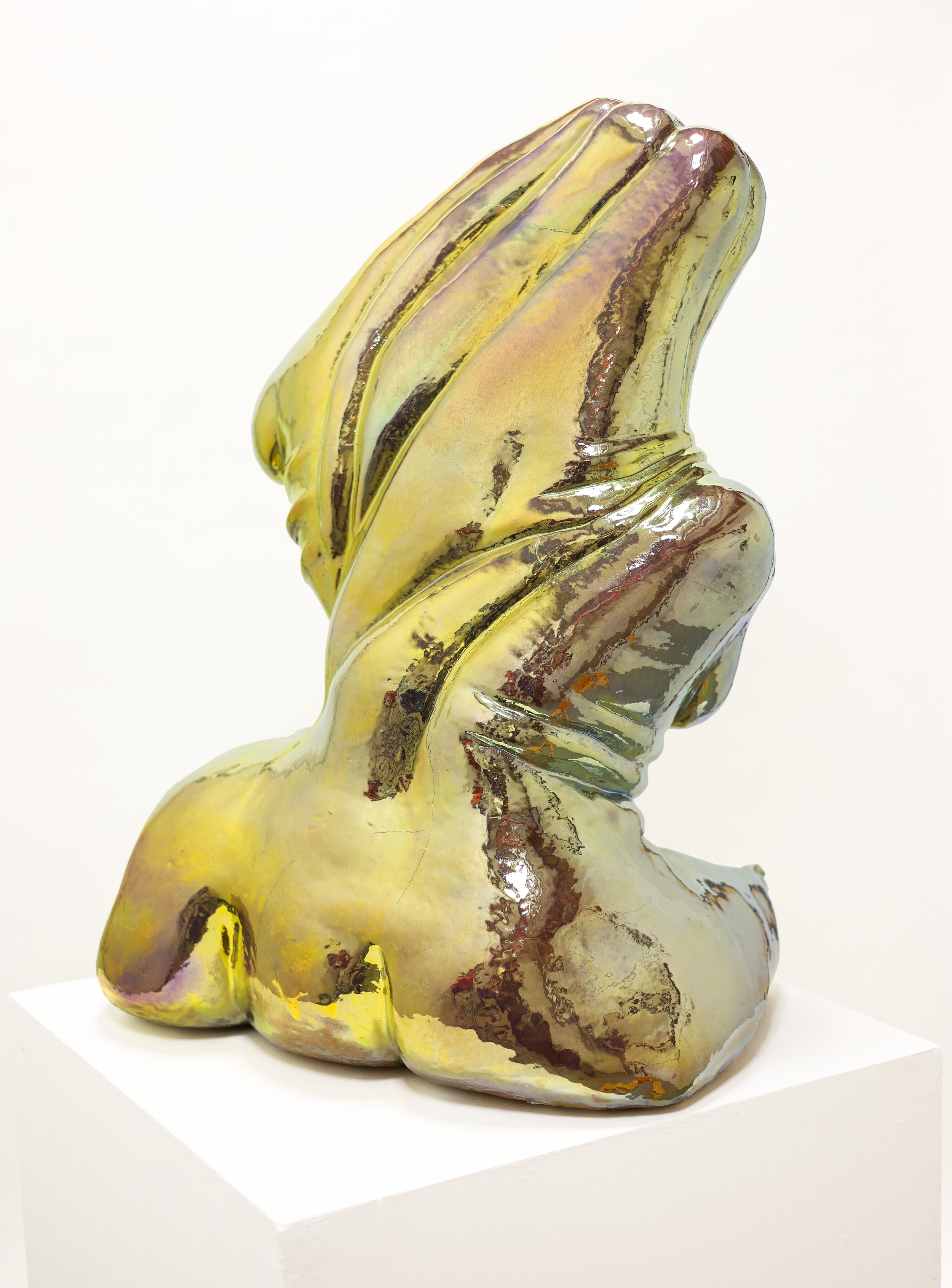
I always want to push myself technically or push the limits of clay. Clay is not a very forgiving material, it's limiting in a lot of ways. Working in bronze might be nicer in that sense, but, it’s expensive. Clay is a cost-effective way of making. In school growing up I thought I’d be a painter and a sculptor. I did not enjoy the iterative nature of sculpture: making the mold, making another positive, making another mold to then make the bronze, or casting it in another material. I didn’t like the repetitiveness of this process. So I asked myself, what do I enjoy about sculpture? The answer was: making the clay positive. Back then, I would use the surface of the clay as more of a drawing surface. In my earlier work, I did a lot of painting and drawing on the surface, using ceramic materials as if it were a canvas. Then I started to do more of the in-glaze luster.
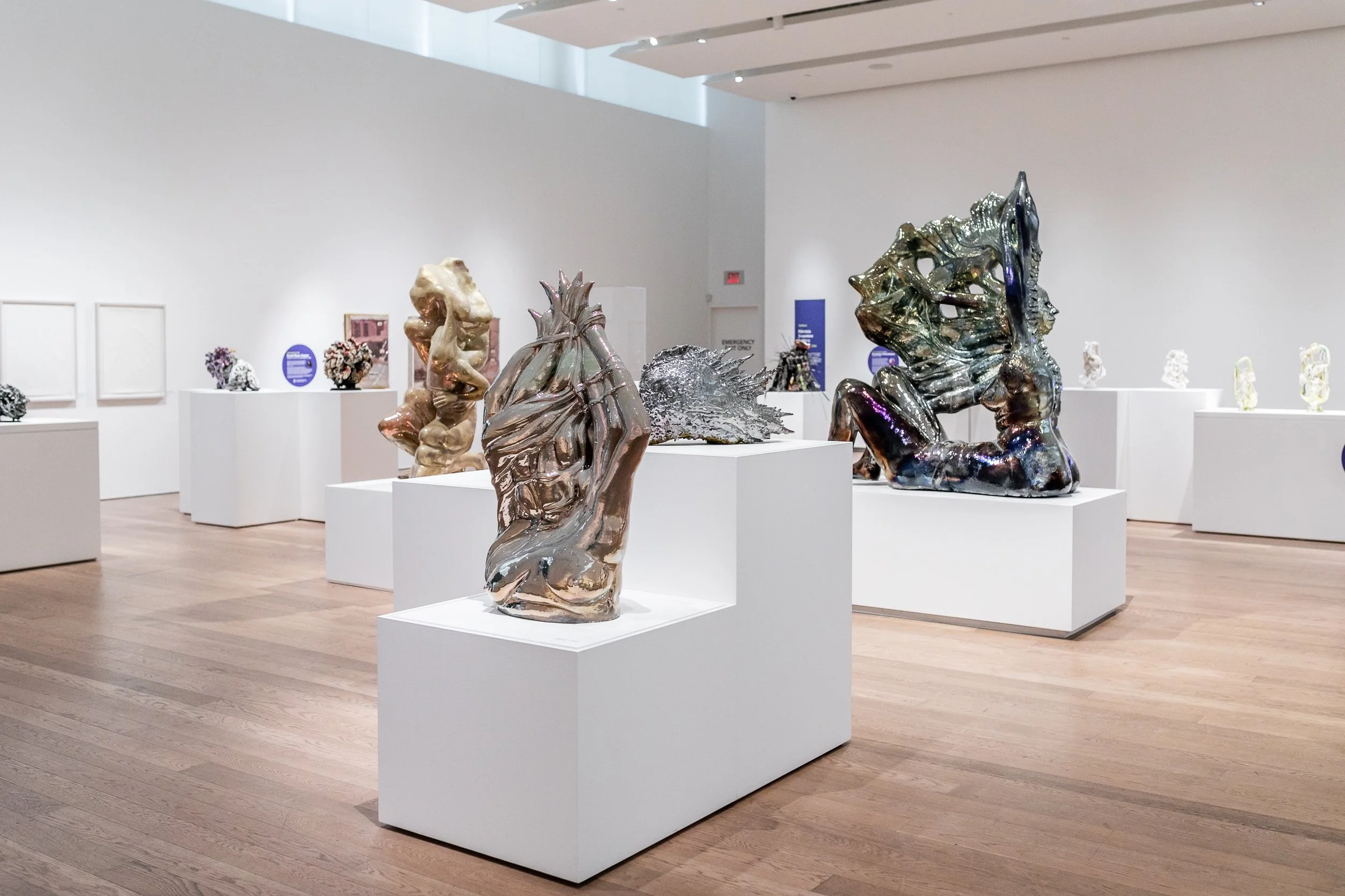
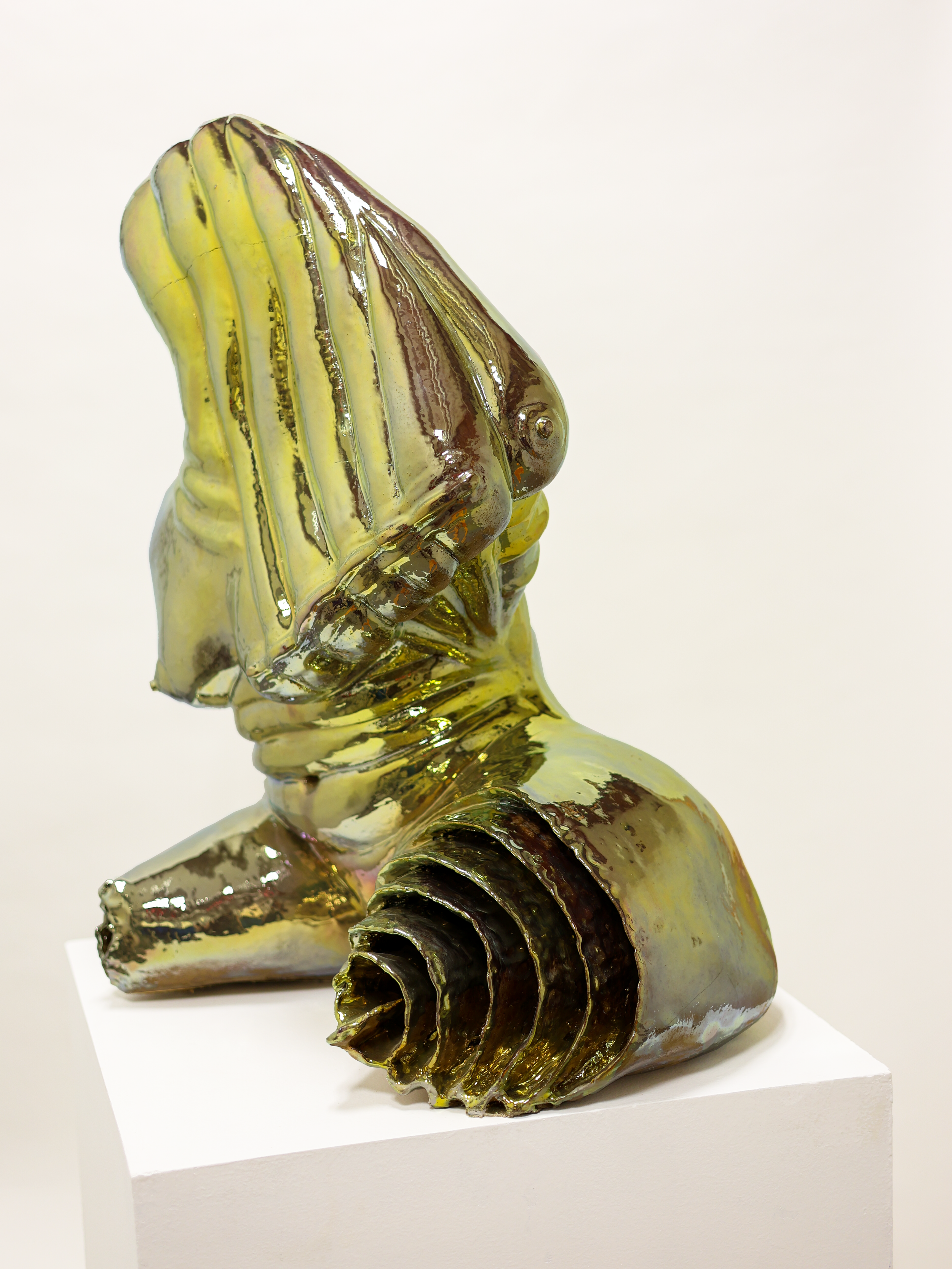
I talk about the idea of the mirror and distortion because when you look at the work, you become distorted. The luster has been daunting to photograph and I have been wanting to get away from doing the the lustered surface. The one thing that is nice about the lustered surface is that it replicates metal.
In this book that I'm reading, it talks about monstrosity. It says something about monsters being god's only neighbor and suggests their proximity to the divine. I'm fascinated by monstrosity, particularly female monstrosity, in relation to godliness and anything outside of the norm that is seen as alien.

BY: Along with themes of the grotesque, the distortion of femininity, the male gaze, and deities, your work feels self-reflective–which is why I was drawn to it. Do people bring up Sci-Fi references when viewing your work?
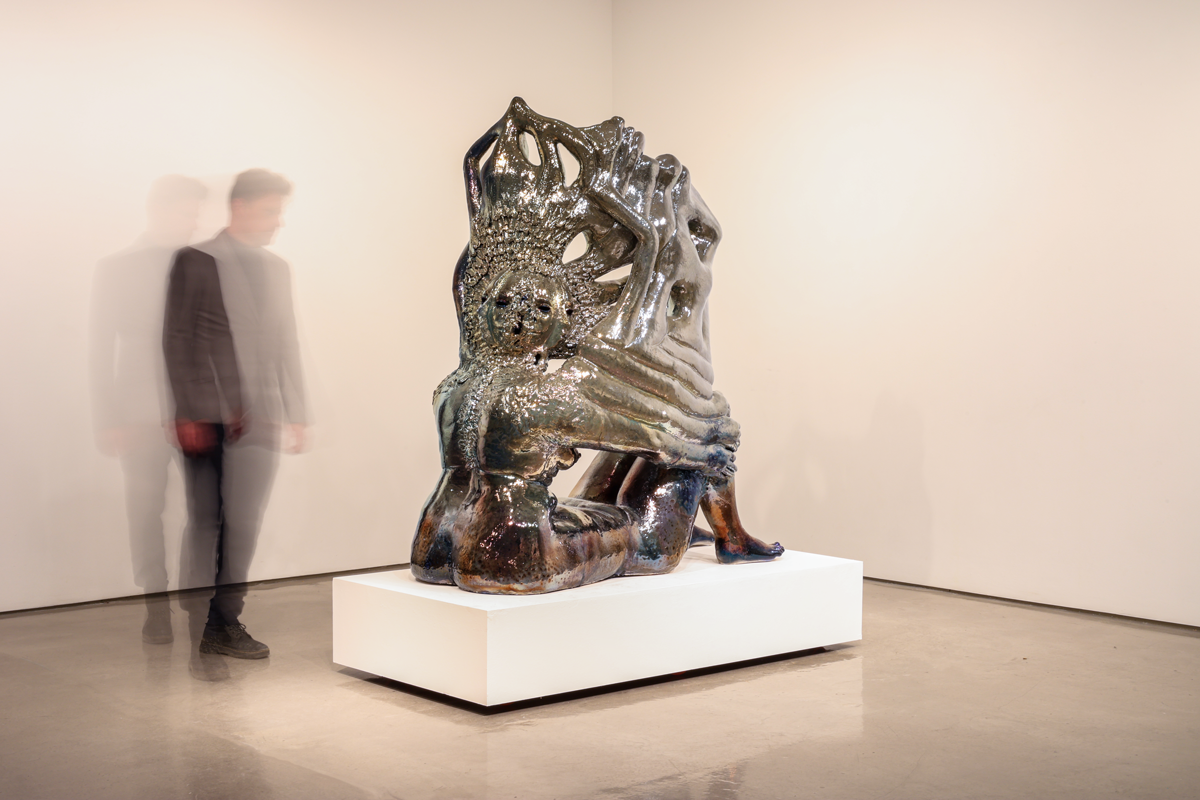
SH: Yes, many Sci-Fi references, to film especially. Another thing people bring up is the imagery of deities within Indian and Hindu culture. It’s interesting because I'm not looking at that as a reference, but I think it's the most famous example of bodies in this kind of movement. Or in the historical context of bodies in motion. There are many examples of this duplication imagery, for example, there's the Roman Janus. It shows up in a lot of Western culture too. As well as in medieval text and depictions of monsters or angels in that realm. People have wanted to sculpt something beyond themselves forever. So usually my response is that I'm not directly sculpting Kali (or Kalika, the Hindu goddess) or referencing it.
BY: Do you feel a carnival mirror or warped mirror is perhaps more accurate than a regular mirror in that it reinforces and reveals the systems of vision that exist?
SH: Yes. And I guess I do use mimesis to show that. It’s the same but different. The mirror in general represents the reflection of the male gaze. Many feminists believe that women don't exist because we haven't found our language. We haven't been able to exist outside of the male order of things.
BT: What are your feelings about male philosophers discussing femininity within this context? What about binaries in that regard?
SH: It's a paradox, I think, identifying as femme or female in academia. Many female philosophers talk about that and the devaluation that happens in their writing. For example, women generally need their ideas to be proven undeniably before they can talk about them. Whereas men are allowed speculation. They get to imagine spaces and receive credit for that imagination too. I’ve shown male artists who inspire me during talks or while teaching and somebody in the audience will comment and say, “You like a lot of male artists”. I feel equally inspired by many humans. I think it's more divisive when people try to speak about it in that binary way. You know? It's othering.
BT: I agree. In that same light, your work embodies shapeshifting and the in-between as you describe. Do your works have their own voice or selfhood that you can visualize? What do you think they would say about their perception of themselves or about gender (in general)?
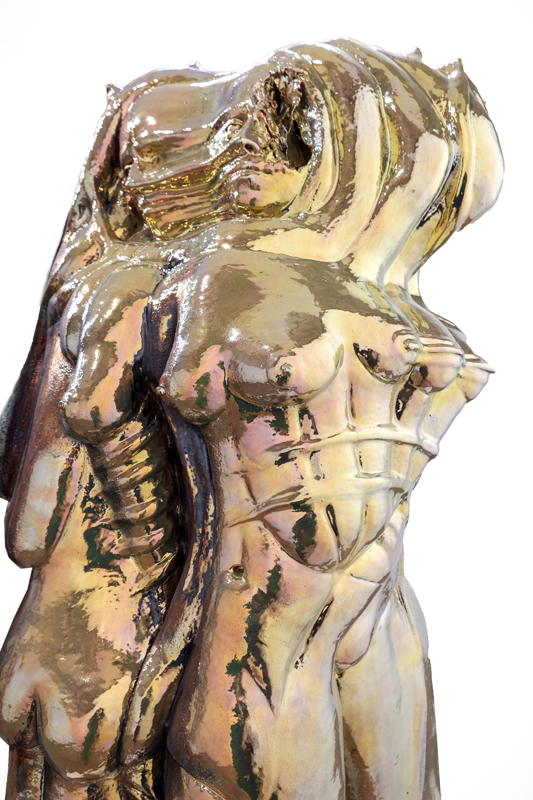
SH: They feel like they're in both realms, and I think that's why, in a way, they embody angels, monsters, and divine creatures. That’s where the intrigue comes from, sometimes they have a lot of awe or angst in them. Or sometimes they’re kind of terrifying and I’m like, wow, I made that haha. I’ll have nightmares with my work in it. Apparently, I have this thing called Hypnagogia—a form of lucid dreaming. So I’ll be awake…but I’m not. It’s getting worse as I get older. Similar to sleepwalking, I’ll get up and walk around in that half-asleep state but I’ll be seeing things, visions, or another reality.
As far as shape-shifting, the in-between, and the perception of self and gender, much of my research began with feminist theory. I think the deconstruction came about because I was trying to understand what it is to be a woman in a society. Or what it means to be a woman in general because I never felt like I fit that box or I didn't understand my gender fluidity growing up. So I tried to dive into the structures that were set and understand how gender is formed. I (and maybe my works as well) asked: where am I different? or how do I fit into this? I’m still researching and learning about this for myself and how it fits into my work. Particularly concepts of non-binary, genderlessness, and fluidity in general.
BT: The idea of labeling oneself can add a lot of pressure.
SH: Absolutely. For a long time, I didn’t want to be in a box.
BT: It’s ironic, isn’t it? The whole point of non-binary and aspects of queerness is to get rid of those rigid, set, or exclusive boxes in the first place.
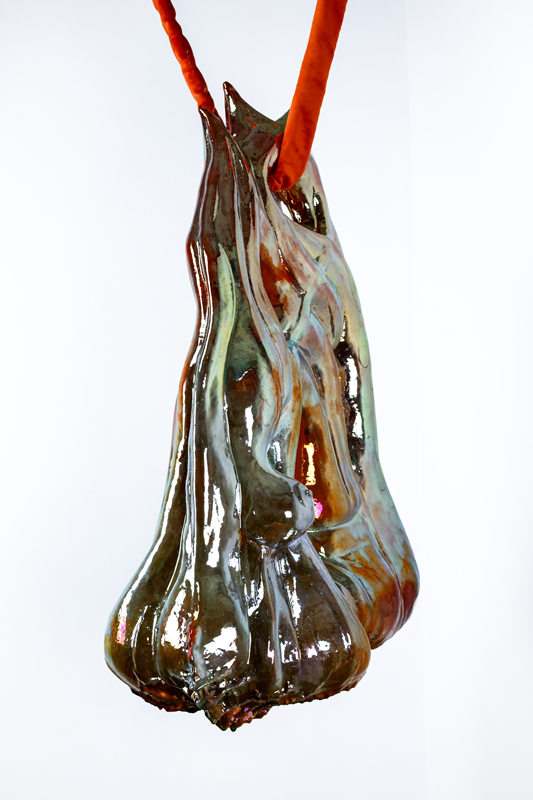
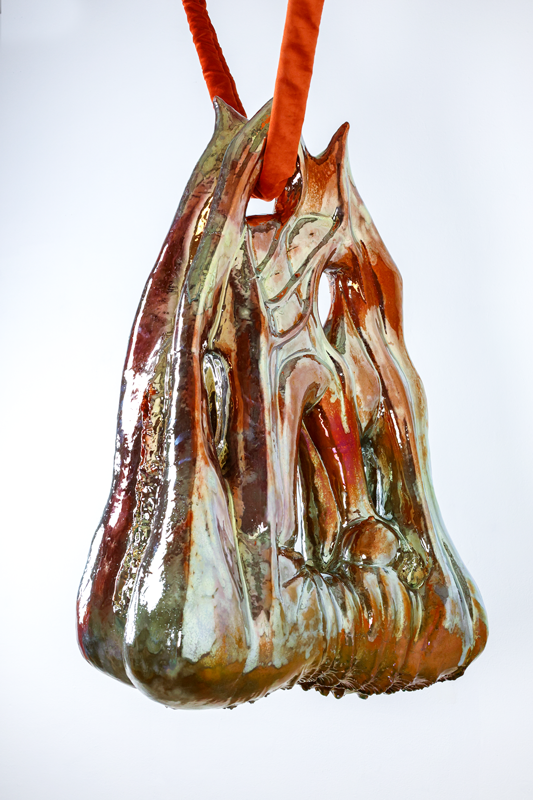
SH: Right, it’s something I think about a lot, especially because I have children. I navigate my awareness along with theirs, ideas of invisibility, and feelings of not fitting in with cis-gendered people. Within academia it’s tricky too, that rigidity lingers when it comes to gender. I think it's because I have given birth that people don’t want to grant me the nonbinary status in their brain or something. It’s interesting because I never actually thought I was going to be a parent, but, it turns out to be so hopeful. It gives me a lot of joy. I don't take it take my children for granted or I try not to.
BT: I’ve wanted to ask you about these topics: the confusion of being tied to femininity, identifying as non-binary, and not wanting to be put in a box, all while having given birth. I have many mixed feelings about it all. I get quite emotional when I think about birth and children and I don't know why it’s such a visceral reaction. I've always thought I didn't want kids but whenever I hear about my friends getting pregnant or I think about the possibility of my own, it makes me cry. It's a strange bodily reaction, partially because of all these conflicting elements surrounding how I feel about gender. How do you navigate the confusion of what you're “supposed” to do in the body that people perceive?
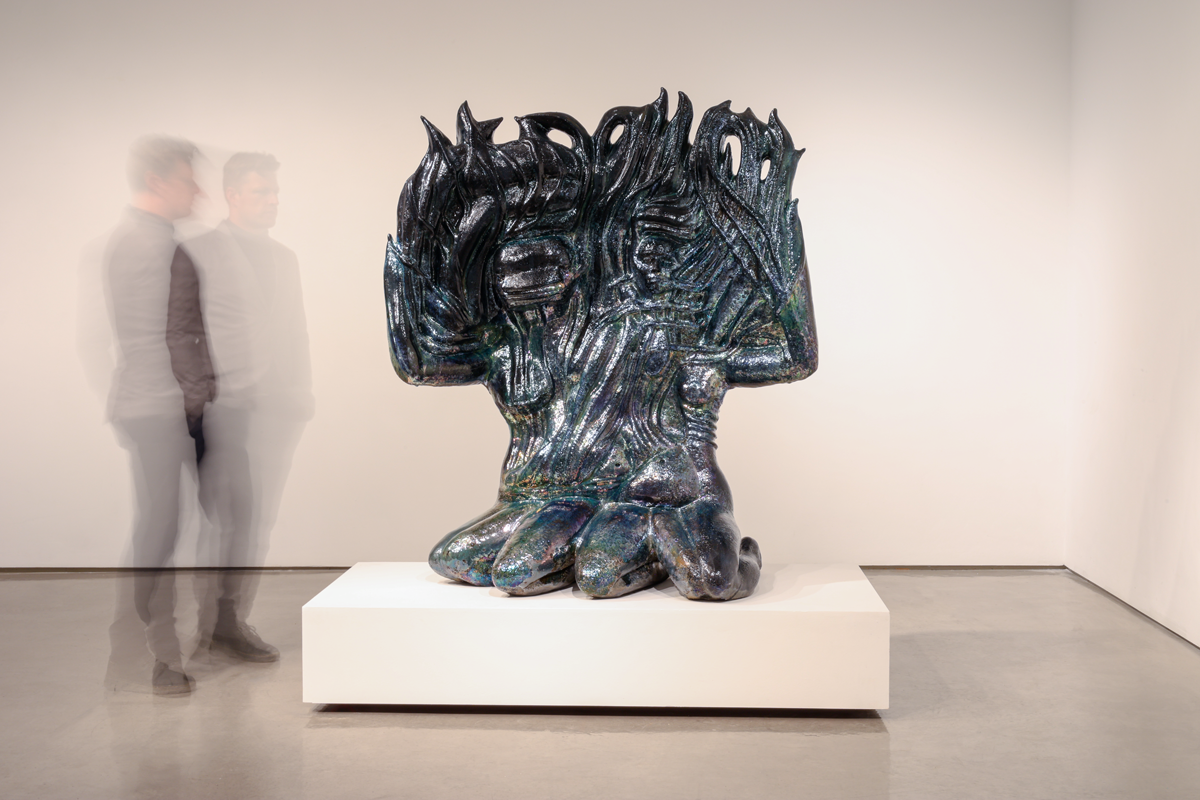
SH: Pregnancy is pretty dysmorphic for me. I don't enjoy it very much. Of course, everyone has different experiences. You become symbiotic with somebody else and it’s a love you've never felt before, you know, all the things that they tell you. It feels hopeful, in the sense that maybe you can change something. Make a better future for them through education, etc. I don’t know, maybe it is selfish in some ways. Needing the ego to heal itself through children or work through my wounds of childhood. Again, thinking about wounds, openings, and vulnerability, there’s this sculpture I did where these hands crawl out of a vagina. I do think it resembles giving birth to yourself, into the world. A lot of trans people relate to this idea of becoming who they are on the outside versus the inside–or navigating perception.
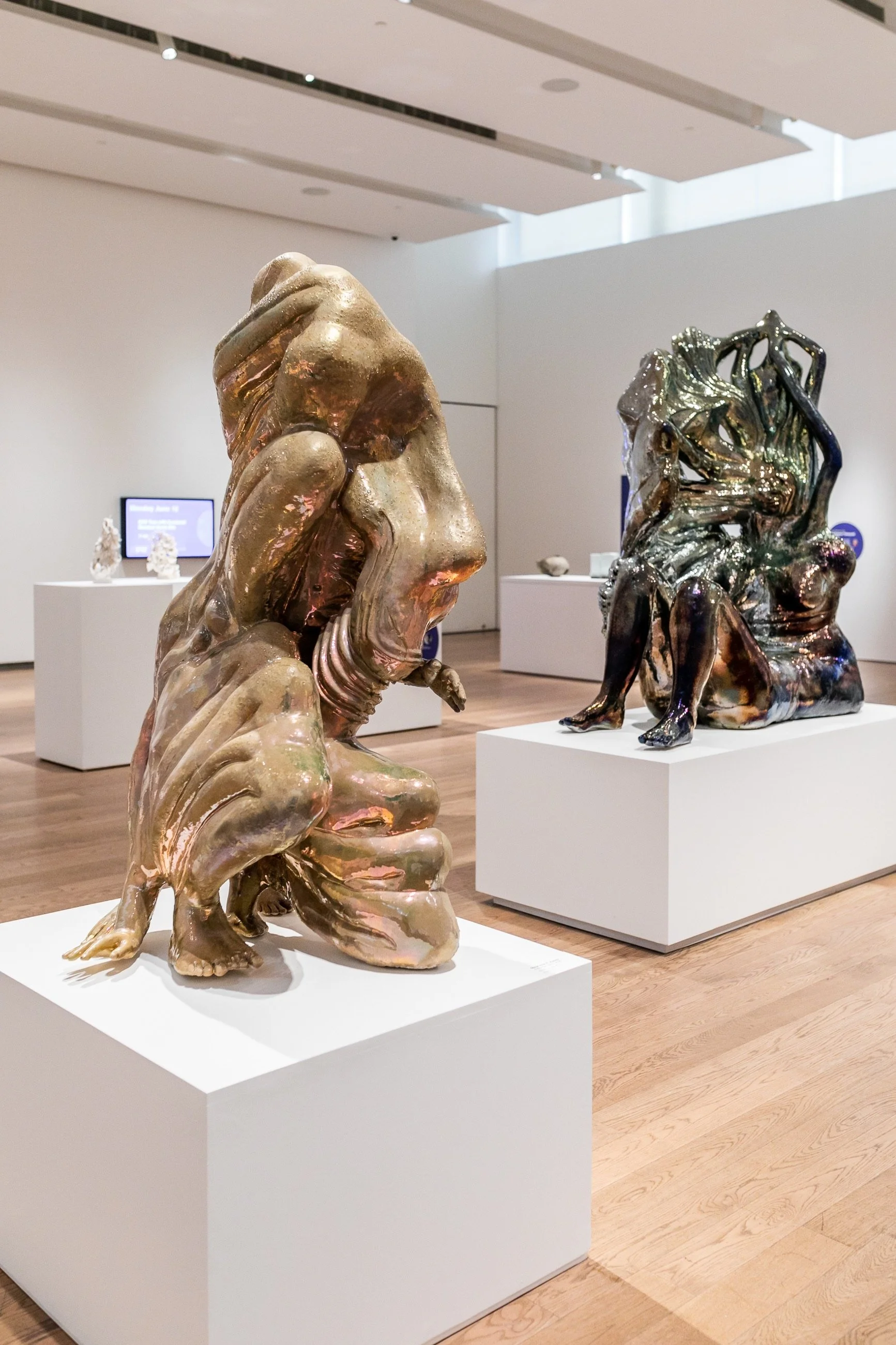
BT: Right, or a representation of constant rebirths, trying to find a way to birth yourself, and a safe space to do that.
SH: Right, and I try to bridge the gap between uncanny, grotesque, and unnerving. I’m curious about what is processable for people. Especially with themes of feeling at home versus alien to your own body. As well as how the body is linked to culture and history, and how they can exist simultaneously together. Then it creates an alien/human hybrid in a way. This is the birthing I see in the work. There’s always a becoming and transformational quality pushing to the future, which the shiny surfaces resemble. I’m still figuring out the connections between cyborg manifestos, technology, and the medium of clay too.
I think a lot of the works feel like they’re being birthed, birth is so violent. It’s the moment between life and death–which is the violence of living in a lot of ways for women, non-binary, trans, and non-conforming people. There is a violence of becoming. The work reflects that as well. I just hope that people feel self-reflective when they look at my work and question what it’s about. They’re not creatures, they’re beings.
Stephanie E. Hanes was born in Alberta, Canada. In 2009 they received a BFA from The Nova Scotia College of Art and Design University in Halifax, Canada. Hanes is an MFA Graduate of Ceramics at the Rhode Island School Of Design in 2017 and received the prestigious Toby Devan Lewis Fellowship for a graduate student with exceptional promise. Stephanie was one of six artists awarded the 2020 NCECA Emerging Artist Prize. In addition, they have exhibited Internationally with a solo show at C.R.E.T.A Rome Gallery in Italy and several group shows at Lefebvre et Fils Gallery in Paris, France. Recently,Stephanie exhibited Bronze and Glass works with Secci Contemporary in Florence, Italy. They have exhibited their ceramic sculptures throughout the USA and Canada at several museum group shows: they were featured artist at the Gardiner Museum in Toronto, Nora Eccles Harrison Museum of Art, The Daum Museum of Contemporary Art, Arizona State University Museum, The Fuller Craft Museum, and RISD Museum Gelman Gallery. They have shown with galleries in Portland with Eutectic Gallery, Seasons Gallery in Seattle, Five Car Garage in Los Angeles, and The Untitled Space In New York City. Hanes is an Assistant Professor in Ceramic Art at New York College Of Ceramics at Alfred University, where they teach ceramic sculpture.